Thursday, March 26, 2015

What have the main fronts been in ostrich husbandry research?


 Horizon-scanning the ostrich industry with bibliometric indicators

From the domestication of the ostrich to the deregulation of the industry, the ostrich industry experienced rapid growth and changes in research, intellectual property, innovation and technology transfer. Ostrich production is typical of industrial agriculture, which combines techno-scientific methods with an intensive agro-processing value chain. Since the processing of the leather, meat, feathers and skins requires substantial technological know-how and advanced equipment, it has resulted in vast amounts of research and advisory literature emerging from private companies, co-operatives and industry organisations. Researchers conducting literature studies face an increasingly complex amount of literature, and the ‘research landscape’ is also in a continuous state of change. This article turns a vice into a virtue: it deals with the analysis and mapping of the large volumes of academic literature on ostrich husbandry found in the Google Scholar database (GS) by means of a word analysis of titles and keywords in abstracts to determine ostrich-related ‘research foci’.

The results suggest that there are associations between the deregulation of the industry and increased emerging ostrich research, between the time of political isolation of South Africa and substantially increased global research on ostrich reproduction by 1996, and between epidemiological research and the outbreak of the avian influenza virus between 2004 and 2006. This indicative study contributes to the development of a novel prototype for the prediction of future developments and trends in agricultural research

For more information download article from

http://www.afjare.org/resources/issues/vol_10_no1/5%20%20Pittaway%20%20Van%20Niekerk.pdf
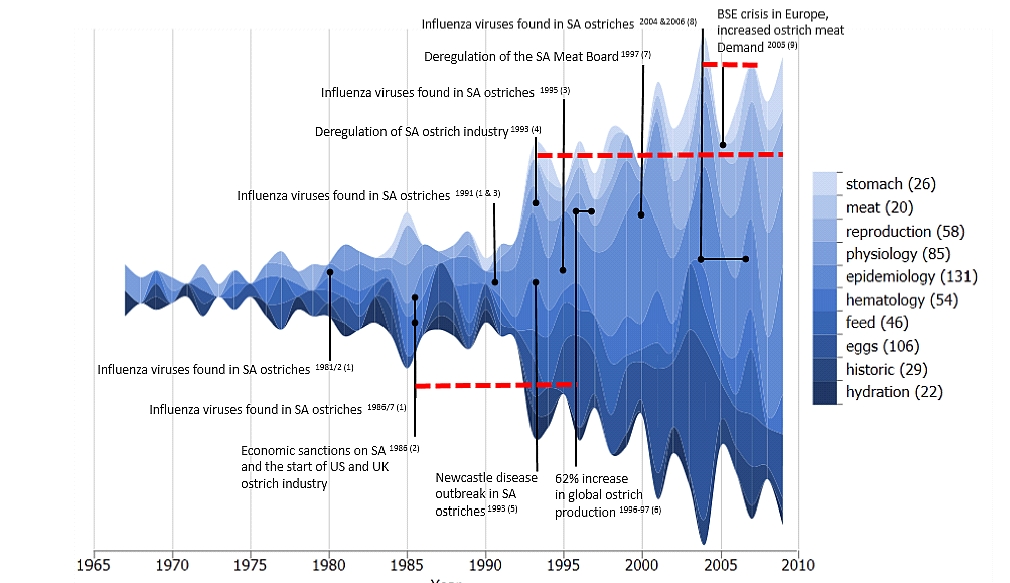
ostrich research front

Thursday, March 03, 2011

The heat is on for ostriches in South Africa

In the Klein Karoo extreme heat has plagued the ostrich farmers again. About 250 ostriches have died from heat exposure in temperatures of more than 50 degrees Celsius, Beeld newspaper reported on Thursday (10 February 2011).

Birds of between four and five months old that were vulnerable to heat exposure. Ostriches of this age cost about R2 500 per bird (250 x  R2500 is estimated @ about ZAR625,000 / $100,000 losses). Climate change and extended summers may result in ostrich growing areas like the Karroo susceptible to increased ostrich fatalities in the future.


"Dr Adriaan Olivier, head veterinarian and manager of research and development at the Klein Karoo International Farms, said that the ostriches were not able to cool down as the temperature of the air was warmer than their body temperature of 38 degrees Celsius. "The only way that these semi-desert birds can cool down is to gasp but this doesn't work when it is so hot and ostriches die of organ failure,"
http://www.news24.com/SouthAfrica/News/Heatwave-kills-250-ostriches-20100211

Sunday, December 26, 2010

Exotic leather sector in South Africa is undergoing rapid change

The exotic leather sector in South Africa is undergoing rapid change because of globalisation, improving global delivery times, a global speed-up of the rate of change in the business environment, improved market responses, highly competitive cheaper leathers and substitute pleather market (more market responsive production cycle)

Saturday, October 02, 2010

Pink ostrich leather bicycle seat

Mountain bikers have now an opportunity to pimp up the mountain bikes with pink ostrich leather bicycle seats or saddles. SELLE AN-ATOMICA has introduced this very neat and interesting looking Ostrich Leather Saddles for all biking enthusiasts. Introduced as limited edition Ostrich Leather Saddle, it is available in many different colours from Neon Green to Indian Pink.

Cyclists planning to use it in the mountains and mud, might have to add some waterproofing application to the seat. According to Selle An-Atomica it is a “slot for comfortable and healthy riding and also are very sexy...?”

With a Indian pink bicycle saddle, cyclists sure will easily be spotted and tracked in event like the 24 hrs night races such as Transbaviaans in South Africa ;)

Tuesday, April 13, 2010

Ostrich leather artist from Mossel Bay, South Africa (art and craft manufacturing)

Situated in Mossel Bay, South Africa, Leather Artist, an art and craft manufacturing came to life in September 2009, by Jaco Steyl

Designing and artwork have always been a passion of mine. From the young age of 5 years my parents noticed my talent and have supported my efforts since then. Art brings inner peace and happiness, which I believe are the building blocks for a healthy relationship with yourself and others.

Not surprisingly, art became my eventual tertiary field of study. I completed my national diploma in textile design at Port
Elizabeth University of Technology and have been doing part-time creative work
since then.


I realised that most suppliers of ostrich leather offer product ranges consisting of
mainly clothing, shoes and fashion accessories. Decorative household items and
genuine artwork are hard to find. Leather Artist was created to offer that something
special and unique.

Ostrich leather is known as exotic leather with a beautiful texture. It is this unique
texture that brings the artwork to life. I have tried to capture the spirit of Africa with
themes such as African Children, Mother and Child and African Sunsets, painted on
ostrich leg skin leather. I am currently working on a range of African wildlife but am
not restricted to African themes. Floral paintings, for example the Strelitzia, also
work well on the leg skin.

I also manufacture products such as coasters and pot stands from ostrich leg skin and
serviette rings made from either leg or body skins. All raw materials are sourced
locally and all work is done by me, Jaco Steyl, to ensure the highest possible quality.
It is my mission to build a business that will enable me to employ people from local,
previously disadvantaged communities to help them develop and refine their skills. I
will continue to dream and design as it is a special talent I have been blessed with and
am grateful for.

Wednesday, February 24, 2010

Pimping Land Rover with an ostrich leather gaiter


Ostrich leather gaiter for Land Rover. Developed together with Ostrich Emporium South Africa

Giving Land Rover that stylish exotic leather finish. Ostrich leather is suited for the interior of vehicles and can with stand much wear due to the quill protection.

Ostrich leather finished in waxy coating for water proofing and UV protection.

Saturday, February 13, 2010

South Africa heat wave killing ostriches

According to news24.com. " In Oudtshoorn - At least 250 ostriches have died from heat exposure in temperatures of more than 50 degrees Celsius in Oudtshoorn in the Klein Karoo, Beeld reported on Thursday.  Dr Adriaan Olivier, head veterinarian and manager of research and development at the Klein Karoo International Farms, said 100 birds had died on one farm and other farms had suffered losses of between 30 and 70 birds. Anton Kruger, CEO of the SA Ostrich Chamber of Commerce, said it was usually birds of between four and five months old that were vulnerable to heat exposure. Ostriches of this age cost about R2 300 per bird."

Does this mean more skins available on the market ???


"Because of the heat, the meat started to rot immediately. The fat under the skin started to cook, which damaged the skin," said Kruger.

The Eastern Cape Herald reported that the number of ostriches that died from this heat wave was over 1000 (http://www.theherald.co.za/article.aspx?id=530164).

The Garden Route in South Africa which produces 80% of the worlds ostrich products is under tremendous water shortage stress and this may have implications to the market over the next 12 months.

Friday, February 05, 2010

Eat or be eaten

Kampala – An angry Ugandan minister has stirred up murky waters by urging villagers on the shores of Lake Victoria to hunt and eat crocodiles that have been munching up locals.

Villagers in the Bugiri and Mayuge districts in eastern Uganda have for years complained that crocodiles attack fishermen and people fetching water or firewood around the shores of Africa’s largest lake.

Although no official statistics are available, it is believed the cold-blooded predators devour dozens of Ugandans each year. Press reports said that in the past two weeks alone, crocodiles have eaten six people in the Mayuge district.

Deputy agriculture minister Aggrey Bagiire, who represents one of the constituencies in the area, has been urging people to strike back.

Bagiire said: I’ve seen the remains of someone who had been killed by these crocodiles. They are on the rampage. It is incredible.

“We’ve brought this to the attention of the government… people should be allowed to hunt and kill these crocodiles.”

Ugandans do not traditionally eat crocodile meat, Bagiire said, but called on the government to allow hunting because “people’s lives are in danger.”

Attacks

Crocodile meat is considered an exotic delicacy in neighbouring Kenya, where farms rear thousands of the reptiles and send the meat to upmarket restaurants. The meat is said to be delicious, although rather tough.

However, the calls to allow the hunting of crocodiles in Uganda provoked angry reactions from conservation officials and wildlife staff in the area, who have threatened to arrest anyone found to have killed a crocodile.

A senior official with the government-run Uganda Wildlife Authority (UWA) said that people were bringing the attacks upon themselves.

“The people in those areas move in shallow waters and they also fish in shallow waters. They also bathe there and because of that, they are eaten by the crocodiles,” UWA’s Director of Operations Sam Mwandha said.

“They encroach on the territory of the crocodiles.”

Mwandha said that urging people to go crocodile hunting would endanger the lives of villagers as they have no professional skills for killing the crocodiles.

“Crocodile meat is very delicious, but when you tell people to go and hunt the crocodiles, they will be exposed to more danger … the animals will end up killing them instead,” Mwandha said.

Conservation authorities are encouraging people to take precautions and fish in deep waters where the crocodiles do not venture, he added.

Increased human settlements in areas which were formerly natural crocodile habitats have led to sporadic collisions between humans and the reptiles. 04 February, www.24.com

Monday, June 29, 2009

PIRMA AFRICA launches 2010 world cup socccer limited range.


1 July 2009, marks the launch of PIRMA AFRICA 2010 exotic leather soccer range. This is a limited range and will run till 2010 Soccer World Cup (or until stocks last).

The Gladiator II, ostrich leather turf boot will be the flagship for the launch. The concept was to use ostrich leather which is indigenous to South Africa, the hosts of the 2010 Soccer World Cup.

Available to purchase on Bid or Buy for ZAR400.00,

Friday, May 15, 2009

Crocodile soup

 Crocodile soup is a centuries old Chinese cure for asthma and respiratory problems.

Wednesday, May 06, 2009

Producing avian flu antigens in ostrich eggs


"A Japanese ostrich flock is the source for flu mask ingredients.

TOKYO -- Prevention of swine flu may soon come from a surprising source: ostriches.

Yasuhiro Tsukamoto, a professor of veterinary science at Kyoto Prefectural University, keeps a herd of 500 ostriches on a farm in Western Japan.

He isn't breeding the birds for their meat, skins or feathers, but for their melon-sized eggs -- which he doesn't eat.

He instead injects the ostriches with avian flu antigens (weakened viruses), then harvests the antibodies they produce in their eggs."

http://www.forbes.com/2009/05/06/ostrich-japan-flu-healthcare-business-swine.html

Monday, May 04, 2009

Is swine flu good for crocodile meat ?


"The Australian crocodile industry is hoping swine flu may result in a boom in crocodile meat sales.
Keith Cook, from Australian Crocodile Traders, says the crocodile meat industry received a sales boost from mad cow disease, and if swine flu gathers momentum, the industry should benefit again.
He says crocodile meat is the prefect white meat alternative for consumers who have been turned off eating pork.
"It wouldn't be too far from the truth to be able to say it is the closest simile to pork that you're likely to get," he says.
"Taste-wise, texture-wise, the colour, the fat content, it's very, very similar."

http://www.abc.net.au/rural/news/content/200904/s2555817.htm

Monday, March 30, 2009

Cocodrilo del Nilo


Cada artículo de este cuero es único, ninguna creación se parece a otra y esa es una de las razones por las que siempre ha fascinado a diseñadores y los ha inspirado. El producto cocodrilo del Nilo es salvaje e igualmente elegante. La piel incomparable cocodrilo del Nilo refleja su propio brillo y esa belleza natural es reforzada mas allá por nuestra curtiembre resultando colores profundos y reflexivos. Cocodrilo del Nilo siempre ha sido considerado el diamante del cuero, su versatilidad para hacer maletines, cinturones, las famosas botas no es igualada por otro tipo de cuero. Cocodrilo del Nilo es uno de los más valiosos cueros exóticos del mundo y su historia de éxito de conservación es un ejemplo clásico de dirección de la fauna moderna. Estas pieles estan disponibles en hornback y belly.

Monday, March 09, 2009

Ostrich leather versus Crocodile Leather

There are over 22 exotic leathers that compete with each other in the footwear and clothing industry. Their changing pricing relationships and demand make interesting economics.

The seasonal fashion, the chosen design of shoe, changing textures and new tanning finishes have strong influence on the choice of exotic leather to be used. This cycle may be as short lived as 4-6 months at a time.

Presently the alligator and nile crocodile are top crocodile leathers on the market, but how can these exotic leathers effect and influence ostrich leather ?

Certain exotic leathers are preferred on certain products i.e. crocodile leather belly on smaller items (watch straps, purses and shoes) and ostrich leather on a larger items (handbags, boots and garments). This has also partly to do with the size of the skins and available cutting area of the skin.

It is not uncommon that the crocodile leather may be the “flavour” of the season for handbags and results in direct competition with ostrich leather. This is provided that costing and pricing is attractive for manufacturer, retailer and buyer.
Posted by Picasa

Thursday, February 19, 2009

Ostrich leather price in present global economy.

The global leather industry has been influenced in the last four months by payment and credit issues. The textiles, leather machinery and leather industry is ambling on with hope of an improving U.S. and UK economies. The ostrich leather outlook is characterised by conservative and calculated purchasing from ostrich leather buyers.

The leather prices are under strain since Christmas sales have been lower. Ostrich leather sellers are now moving to new economies like Russia, Far East and China to assist with present market conditions.

Sunday, November 09, 2008

Pirma Africa the unique ostrich leather soccer and rugby boot


What is the history of the brand PIRMA?


PIRMA Brazil started production in Mexico in 1990 with one idea in mind: “to be the best”. With over 100 retail stores in Mexico and exporting their world class products to Canada, USA and Costa Rico, makes PIRMA products a sought after soccer and rugby boot for any professional sportsman.
There are 50 soccer playing countries and 34 rugby playing countries in Africa. The potential for PIRMA is huge.


What is the international logo of PIRMA?


“THE BRAND OF CHAMPIONS”


Could you identify one distinguishing factor of PIRMA Brazil?


Yes, their ability for product innovation. It is this major factor that we are sharing with the African continent. A South African ostrich leather sport shoe. In addition to this, they have a quick response time and are setting the global standard for the next generation soccer and rugby boot.


What is so unique about the PIRMA products?


The flagship product is made of South African ostrich leather. It is the first time in the history of the game that an ostrich leather soccer and rugby boot is being launched. And what is more exciting about this, is that it will be ahead of the 2010 World Cup which will take place in South Africa. This will be the boot for this Nation from this Nation. We are so proud that the material for this international acclaimed soccer and rugby boot comes from South Africa.


Tell us more about the PIRMA ostrich leather soccer boot?


These flagship products will consist of three bold, yet dynamic colours. These are 1) Green with yellow (gold) ostrich; 2) Yellow with green ostrich and 3) red with yellow ostrich. The boots will be available with studs or the modern blade technology soles.


How would you describe the product mix of the PIRMA Africa?


As far as our knowledge is concerned, it is the first time in the history of the game, that the spectator can buy a look-a-like sneaker (flat sole comfort shoe) as the soccer boot of his hero playing the game on the field. We believe that it will create a new excitement in the sport shoe industry in South Africa.


Our product mix will consist of: 1) the flagship ostrich leather soccer / rugby boot, followed by various high quality synthetic styles and 2) the total sneaker range for the South African Soccer and Rugby public.


How did PIRMA Africa get involved with this innovative soccer and rugby boot concept?
The three South African Directors of PIRMA Africa (Pty) Ltd are working in the ostrich industry and combined have a total of more that 30 years experience in ostrich leather and leather related products. We have been working very closely with our Mexican counterparts and know their superior product quality. PIRMA is a well known brand amongst the South American countries such as Brazil, Mexico, Chilli, Argentine, Peru etc. and we will see the PIRMA brand in South Africa when these countries play in the 2010 World Cup.


What are your future plans for PIRMA Africa?


The short term plans are to become the sport shoe of choice amongst the South African professional sportsmen. We will focus much of our time to introduce the brand into South Africa and the rest of Africa.

Sunday, October 19, 2008

PIRMA AFRICA launches website with ostrich leather football boots


PIRMA AFRICA, an exotic leather sportwear company has launched their website to Africa. The website introduces for the first time PIRMA AFRICA’s initial catalogue to the market since the companies entry into Africa. The website depicts a fresh new product range for the growing African football market (consisting of exotic leather mixed with synthetic material). 

Some of the boots advertised are fully ostrich leather and/or partially decorated in ostrich leather. The ostrich leather is a typical African leather but a first for the world of football. The next range to be announced is in January 2009 and said to consist of other exotic leathers. This development is going to be interesting to watch on and off the soccer field. The timing for PIRMA AFRICA is ideal for the run up to the 2010 FIFA Worldcup in South Africa. 

Wednesday, September 17, 2008

South African ostrich farmers receiving more - August 2008

Main ostrich processors in South Africa have pushed up the price paid to farmers by up to 20% during August 2008. Other ostrich leather and meat producers accept they will have to do the same to maintain supply. Pricing given for a bird, depending on meat, skin and feather grading has topped +/- ZAR 2800.00 per bird. 

One of the main reasons for the price increase was to assist the increasing feed and fuel costs on the farm. 


Many South African ostrich farmers have stopped ostrich farming due to challenging periods where meat exports were halted twice during the past three years and increasing input farming costs.

Concerns in the market are that the costing will need to be passed onto leather and meat prices at some time. The weakening South Africa Rand has alleviated immediate price increases, but may not be sufficient to hold the increases for much longer.

Source S&V African Leather. 

Monday, August 25, 2008

World first ostrich leather soccer boots for 2010 worldcup

A world first, ostrich leather soccer boots. Ostrich Emporium SA together with a Mexican company PIRMA are working on a new style of soccer boots to be launched before and in conjunction with the 2010 Soccer World Cup in South Africa. The thinking behind the idea was to provide a textured boot (using ostrich quill) to assist spinning the the soccer ball into the goals (to "bend it like beckham"). Unlike the Ostrich Skin Nike Dunk High (http://www.nicekicks.com/ostrich-skin-nike-dunk-high/) these boots are genuine ostrich leather.

Feel free to read more at the following links:

"THANKS to opportunities flowing from the 2010 soccer showpiece, two Nelson Mandela Bay entrepreneurs have teamed up with a Mexican company to produce soccer boots made out of ostrich leather." http://www.theherald.co.za/herald/biz/03_25082008.htm


For more photo's and information visit:
http://www.ostrichemporium.com/ostrichboot.htm

Distributed in South Africa by PIRMA AFRICA